
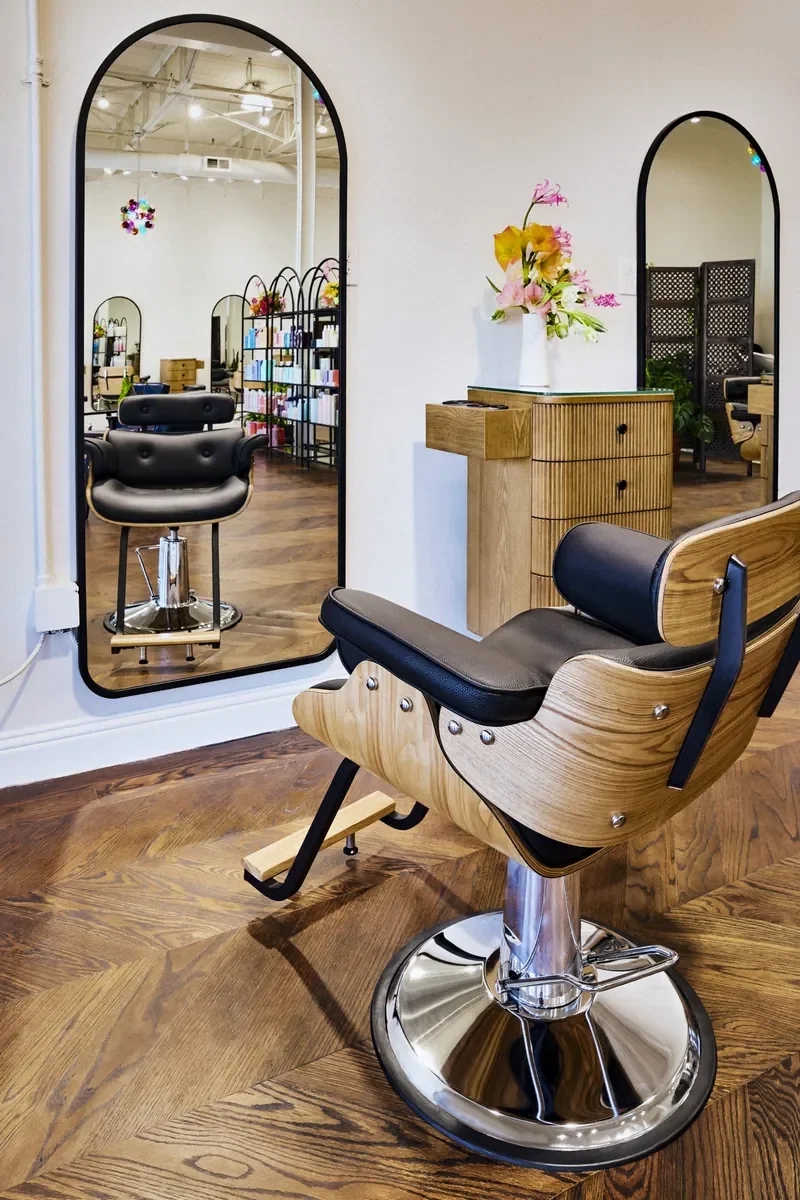
A styling station at Clark & Company Salon in the Dallas Design District
A bixie gets called a grown-out pixie a lot. Revlon Professional, which writes cutting guides for stylists, says it isn't: "The straightforward answer is no." The two cuts are close relatives, but they're built differently, they grow out differently and they keep you on different trim schedules.
Short hair is a big part of what we do at Clark & Company Salon in the Dallas Design District. Our owner, Kaycee Clark, has worked in Dallas hair since 1992. Her cuts placed in the Top 100 for Pixie/Bixie in Behind the Chair's #OneShot Hair Awards in 2024 and 2025, and in the Top 100 for Cut Transformation in 2024, 2025 and 2026. She was also named Best Hair Stylist in the Dallas Observer's Best of Dallas 2026. This guide explains the difference between the two cuts and how to choose.
Clark & Company Salon publishes this guide.
Quick answer: pixie or bixie?
Choose a pixie if you want the shortest, most defined shape, you're happy to have your face fully on display, and you can come in for a trim about every 4 to 6 weeks.
Choose a bixie if you want short hair with more length on top and around the face, more ways to style it, and a little more time between trims (about every 6 to 12 weeks).
Both work on straight, wavy and curly hair. The shape just has to be cut for your texture.
| Pixie | Bixie | |
|---|---|---|
| Shape | "Very short and close to the scalp," with the whole face on display | Shorter, tapered layers at the nape; longer textured layers at the crown; a longer fringe |
| Trims | About every 4–6 weeks | About every 6–12 weeks |
| Daily styling | Quick: usually a little wax or paste for texture | Your choice, from sleek to tousled; more options, sometimes more time |
| Growing it out | Takes a few clean-up visits | Already has length on top and at the fringe |
Shape descriptions and trim intervals come from Revlon Professional's pixie and bixie guides for stylists.
How a pixie and a bixie are built
A pixie is cut close to the head, so there's very little hair framing the face. That's what gives it its clean, graphic look, and it's why Revlon Professional warns stylists that it "puts the entire face on display," which "may not be for everyone." With so little length, growth shows quickly, which is why it needs the most frequent trims.
A bixie keeps a pixie's short nape but borrows the fullness and length of a short bob. Revlon describes "tapered and textured shorter layers at the nape of the neck and longer, longer textured layers towards the crown, and a lengthier fringe," with a rounded crown that gives the illusion of volume. That extra length on top is what makes it more flexible to style, and more forgiving as it grows.
How to choose: five things that matter more than the trend
1. Your texture. On straight hair the lines of a short cut show clearly, so a pixie reads sharp and graphic. Curls soften those lines but shrink. Revlon Professional's curly pixie guide says curly versions "require strategic shaping to accommodate and accentuate natural curl patterns," usually shorter at the sides and back with length on top so the curls have room to move. If your curls shrink a lot, the extra length of a bixie gives you more margin.
2. Your density. Density is how much hair you have, not how thick each strand is. If you have a lot of hair, the shape depends on how your stylist manages bulk at the sides and nape, so ask how they'll handle weight. If your hair is fine or sparse, the rounded crown of a bixie can help: Revlon notes it gives "the illusion of volume."
3. Your growth pattern. A cowlick at the crown, a strong swirl at the nape or a hairline that grows in one direction all shape where a short cut can sit. A pixie leaves the least length to work around them; a bixie's longer top layers give the stylist more room. Show your stylist where your hair stands up or splits before they start, ideally on dry hair worn the way you normally style it.
4. Your styling time. A pixie is usually the fastest morning: a little product and you're done. A bixie can be just as quick if you wear it natural, but it also gives you the option to smooth it, add texture or wear it curly, which can take longer.
5. Your maintenance budget. A pixie that holds its shape means a cut roughly every 4 to 6 weeks; a bixie stretches to 6 to 12. Over a year, that's the bigger cost difference, more than the price of any single cut.
Growing out a pixie
Short-hair stylist Courtney Bond, interviewed by Modern Salon, recommends a couple of clean-ups about 4 to 6 weeks apart, with a full haircut only every 2 or 3 months. The usual plan, she says, is to gain length on top and at the front while keeping the nape short and tight, aiming for a bob first. Often only the nape needs cutting, so those visits can be short.
What to ask your stylist before the cut
- On my hair, would you cut this as a pixie or a bixie, and where will the shortest part sit?
- How will my texture, density and cowlicks change the shape?
- How long can I go between trims before it loses its shape?
- How will I style it on an ordinary morning, and with what product?
- If I want to grow it out later, what's the plan?
Bring photos of short cuts on hair like yours, from more than one angle. Revlon recommends the same for curly pixies.
Booking a short haircut at Clark & Company
Kaycee's page lists "pixies, bixies and major transformations" among her work, and several of our stylists list short hair on their own pages:
| Stylist | Short-hair work on their page | Women's cut (starting price) |
|---|---|---|
| Kaycee Clark | Pixies, bixies and major transformations | $150+ |
| Alissa Capretti | Pixies, bobs and men's cuts | $95+ |
| Pryor McNairy | Short hair and short-hair grow-outs | $95+ |
| Robin Northcutt | Short hair and men's cutting, with graduation techniques | $115+ |
| Dustin | Curls and shorter shapes, for all hair types and identities | $80 |
Prices are each stylist's published starting price as of November 2026. A women's cut includes the shampoo and blow-dry.
To book:
- Pick the stylist whose page and photos look most like the short hair you want. If you're growing out a pixie, Pryor lists grow-outs specifically.
- If your hair is curly, book a curly service instead of a standard cut. Your first curly visit is a Curly Transformation ($225+ with Kaycee), and after that a Curly Cut. Our curly hair page explains both and how to arrive with your hair.
- Book the way the stylist's page says, or call the salon. We ask for at least 24 hours' notice to cancel or reschedule, and a valid card is required to reserve.
Frequently asked questions
Can you get a pixie or bixie with curly hair?
Yes. Curly versions need shaping that accounts for shrinkage and curl pattern, so book with a stylist who cuts curls. At Clark & Company, short curly cuts are booked as curly services.
Which is easier to grow out?
A bixie, because it already has length on top and at the fringe. Growing out a pixie usually takes a few short clean-up visits to keep the nape tidy while the top catches up.
Which takes less time to style every day?
Usually a pixie: a little wax or paste is often enough. A bixie can be just as quick worn natural, but its extra length invites more styling.
Visit us in the Dallas Design District
Clark & Company Salon is at 1130 Dragon Street, Suite 170, in the Dallas Design District. Not sure whether you're a pixie or a bixie? Call us at (214) 242-9250 and we'll match you with a stylist who loves short hair, or browse our stylists to compare their work and prices.